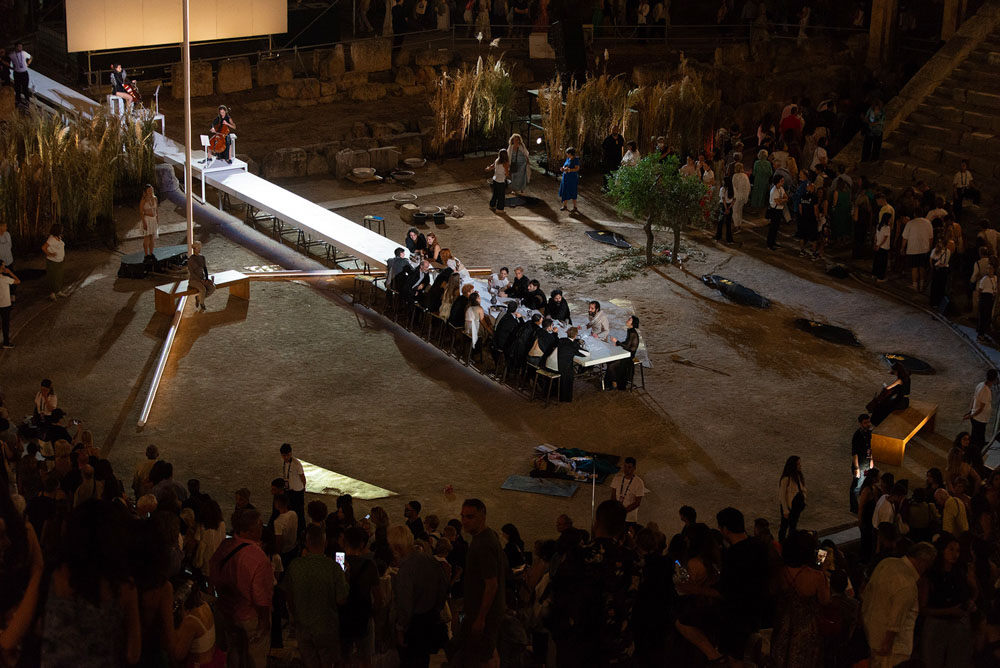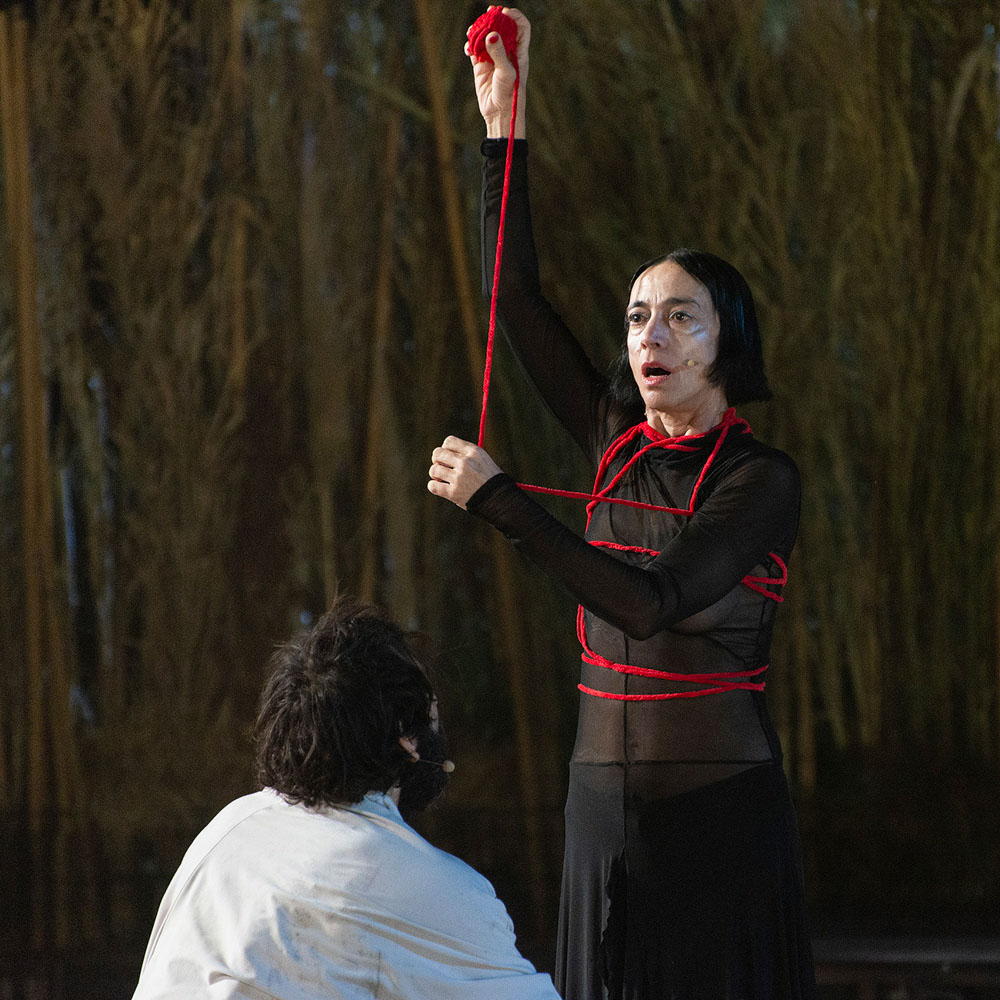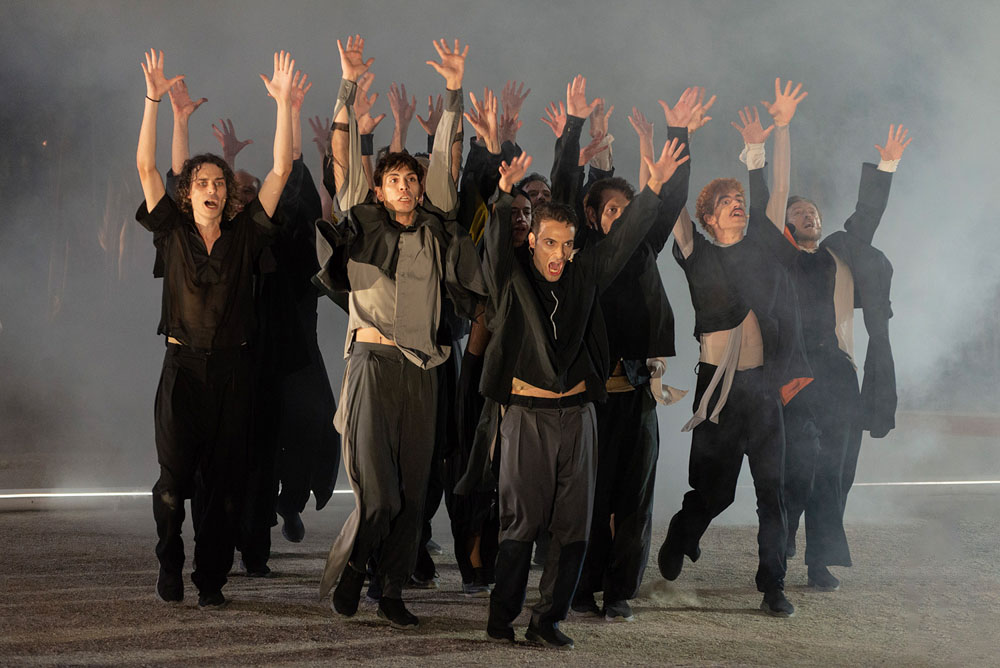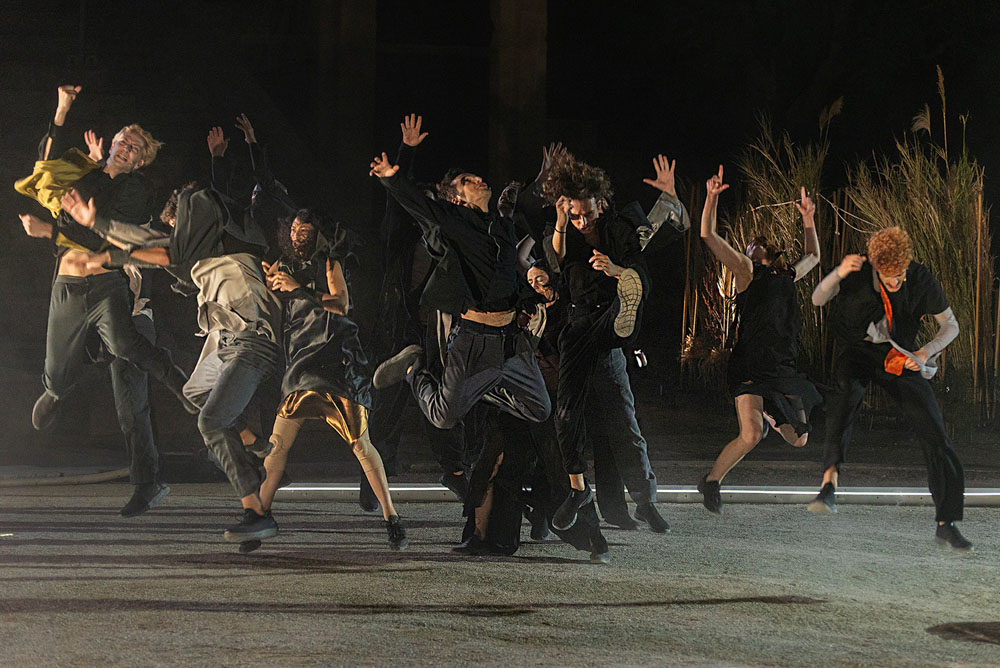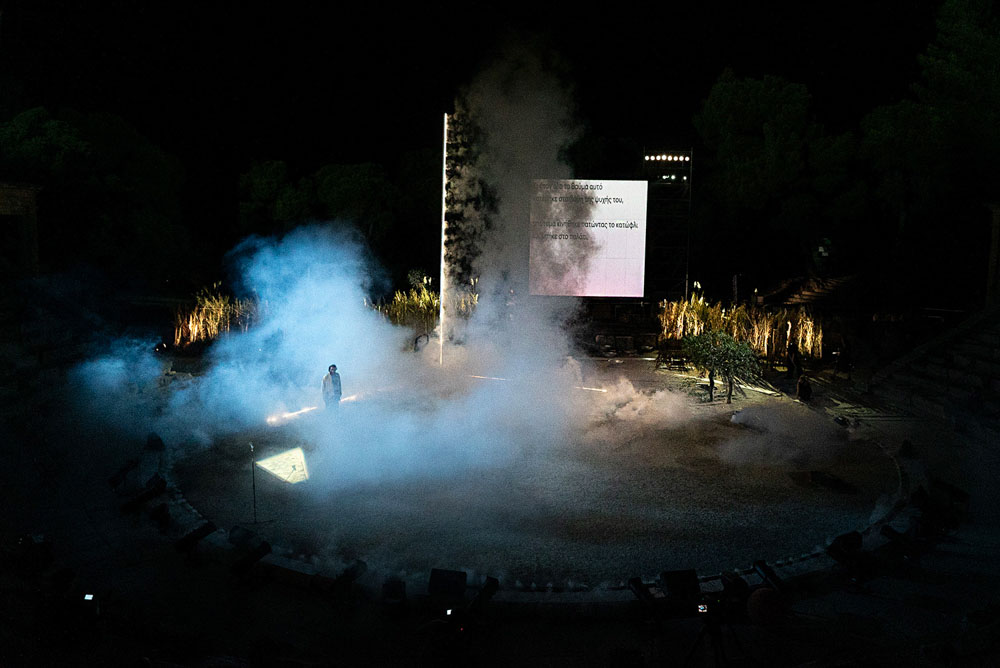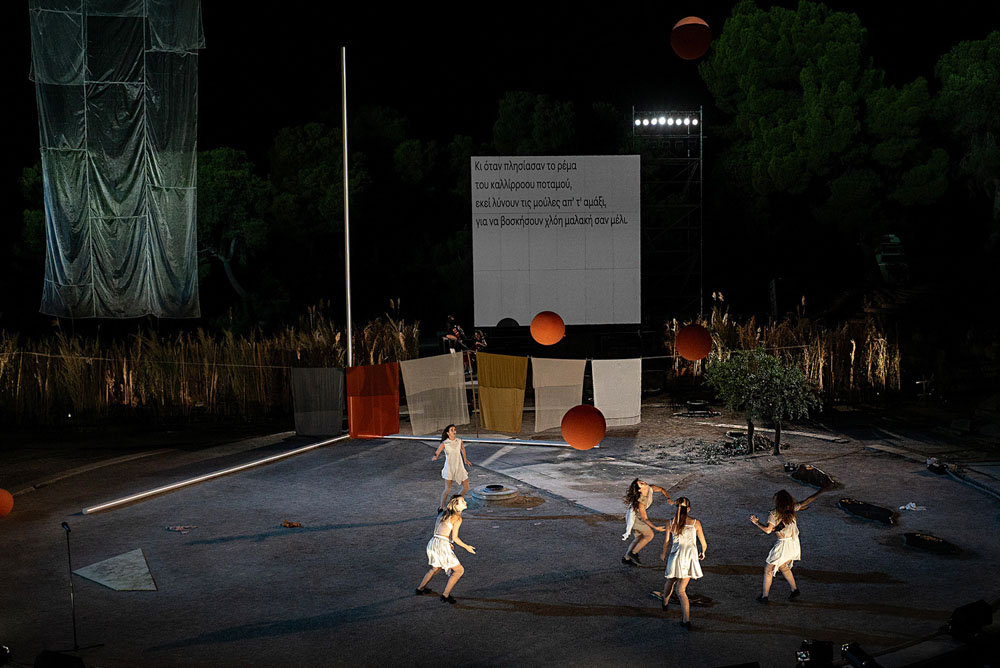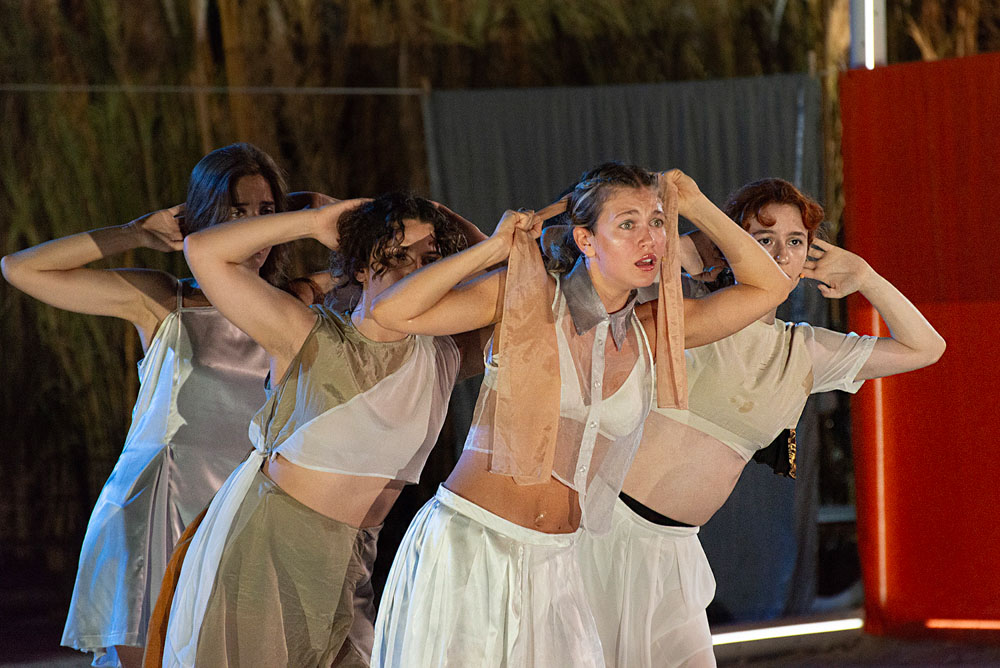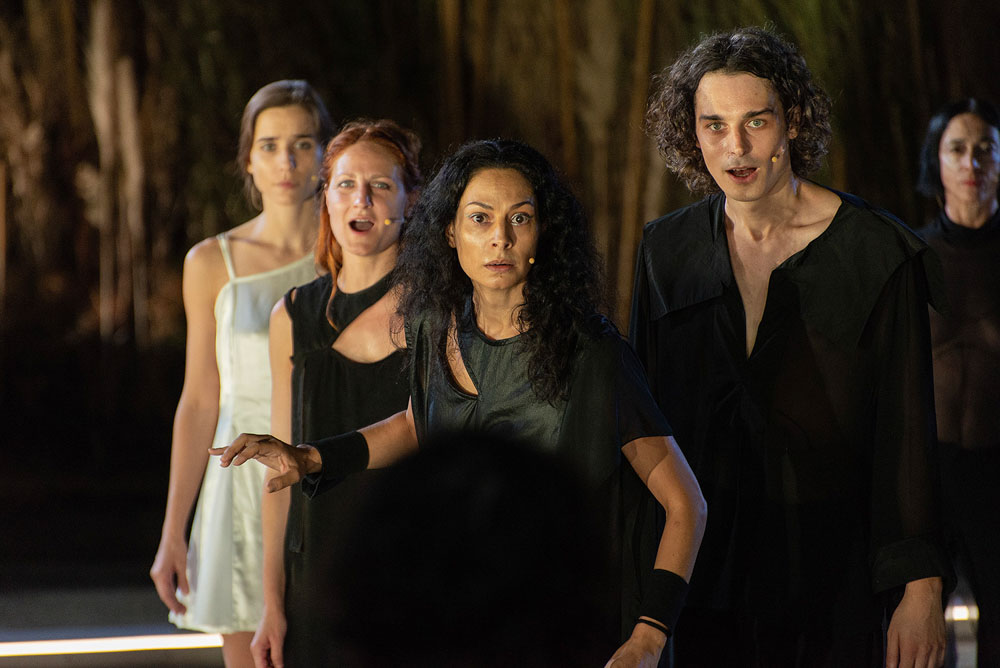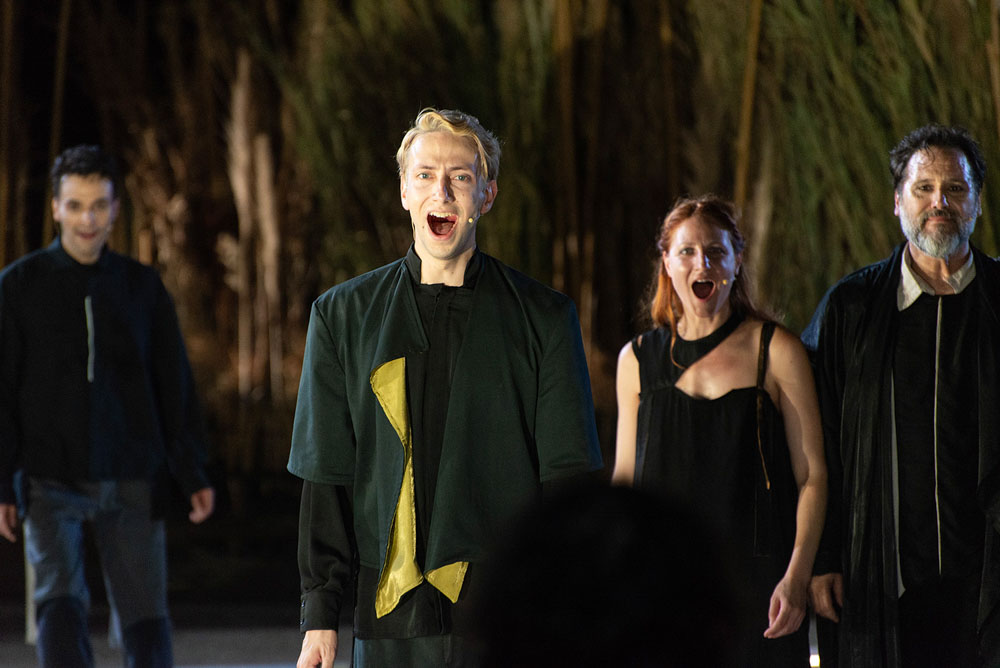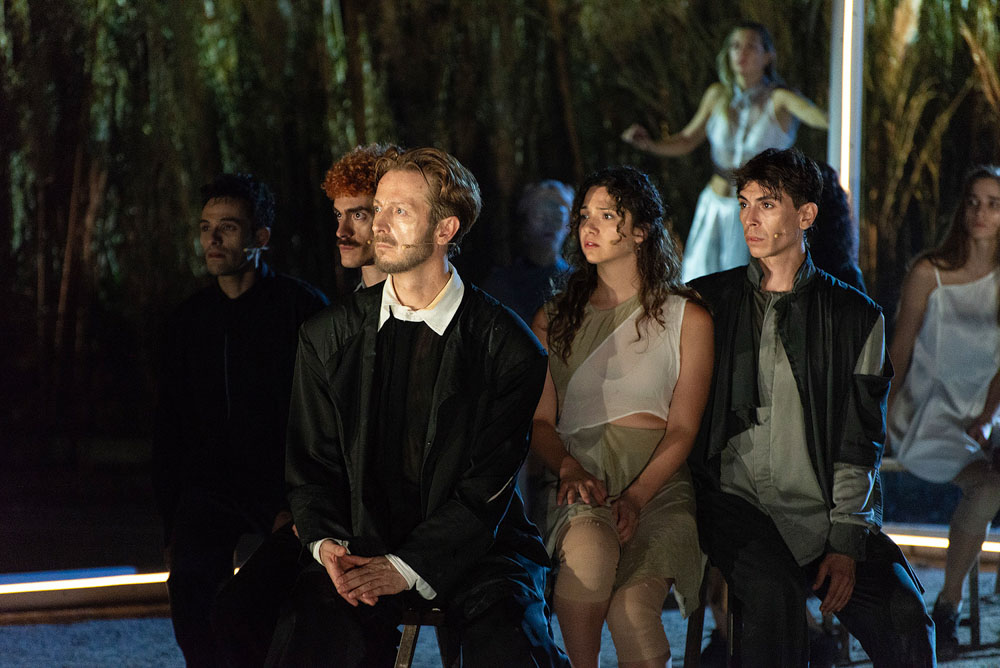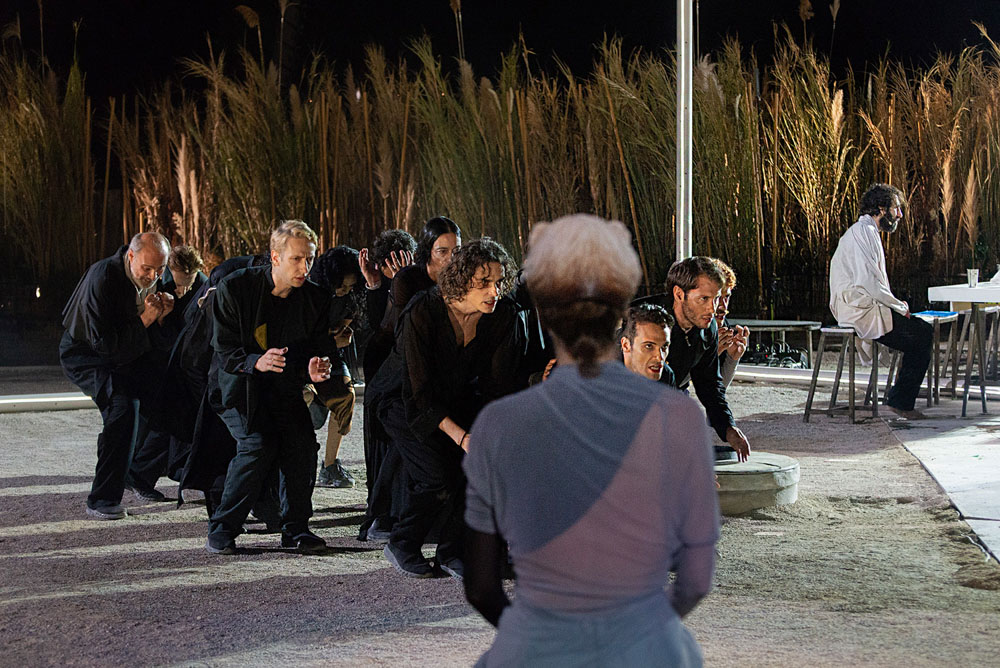

Michael Marmarinos returned with yet another unexpected dramatic proposal, guiding us back to the sources. A visit to three rhapsodies of the epic reveals how this endless mystery of oral narration (the profound mystery of theater) has the power to transport us excitingly “to where history is still happening.”
The performance, a poetic theatrical landscape that transcends the seasons, is a contemporary stage interpretation of the epic that confronts us with the concept of the stranger, in whose difficult position we may all find ourselves, posing timeless questions:
Who is the stranger and who are we?
An existential wandering of the stranger in three rhapsodies.
My noble Alcinous, who stands out among your people,
it is indeed wonderful to hear a good singer,
such as this one, with a voice you would call divine.
And I confess, there is no pleasure more delightful
than when the whole world comes together in joy: in the hall
the guests, seated in rows, listen to the singer
intently, and the tables in front are full
of bread and meat; the cupbearer draws wine from the krater
and passes it around, pouring it into the cups.
I feel deeply that this is the most beautiful thing there is.
Homer’s Odyssey, Rhapsody I, lines 2-11, trans. D.N. Maronitis,
Institute of Modern Greek Studies (Manolis Triantafyllidis Foundation), Aristotle University of Thessaloniki, 2006
*The additional excerpts from the Iliad in the play’s dramaturgy are translated by D. N. Maronitis (Agra, 2012), while the excerpts from Virgil’s Aeneid are translated by Theodoros Papangelis (National Bank of Greece Cultural Foundation, 2018).
In addition, there are fragments from Quintus Smyrnaeus and his work “The Words of Homer,” translated especially for the performance by Yannis Doukas.
DIRECTOR’S NOTE
TEXT ABOUT THE BRONZE AGE
“Everything that lives within the Epic has form, personal substance: horses speak and prophesy, rivers react like living beings, coincidence presupposes a divine hand.
If, for today’s sensibilities, the dawn is a natural phenomenon, for Homer it is a personified manifestation. Thus, we see her rising from her bed… […]
Here, man has not yet undergone the internal schism that will divide his essence into mortal and immortal, rational and irrational. He lives and acts as an unbroken unity, as a psychosomatic whole (unprecedented and unsurpassed in Western culture) without divisions.
*Kostis Papagiorgis, “The Homeric Battle,” Kastaniotis Publications, Athens, 1993, pp. 20-23
Truly, what do we remember from the epic?
To what extent could that Bronze Age—its nostalgia and spirituality, its rawness and ethos—ideally converse with us, shed some light on our own dark times?
To what extent can that culture of Aidos, the relationship with Nature, with God, the divine and the miraculous, the relationship with the stranger – or with that profound mystery of hospitality – have any relevance today, in our own culture? In our own questions today?
After NEKYIA, – that visit to rhapsody l’ in collaboration with Japan’s NO theater, which was first presented in Tokyo and then, for the first time, at the ancient theater of Epidaurus – now another return to the sources …
A visit to three rhapsodies of the epic and how this endless mystery of oral narration (the profound mystery of theater) has the ability to transport us excitingly “there, where history is still happening.”
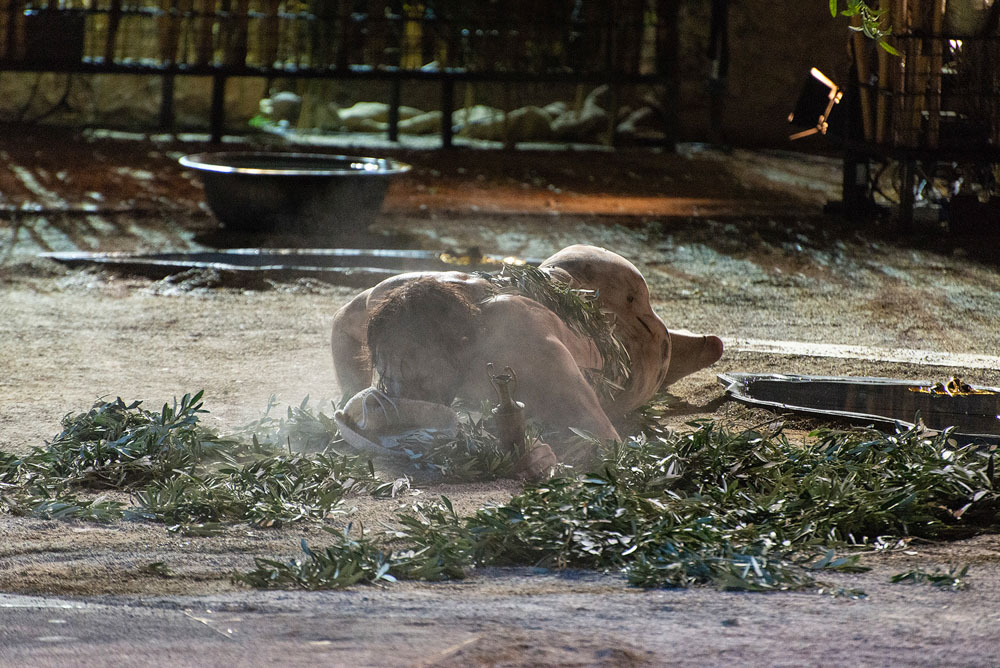
A stranger—and Oios, moreover, named by Homer, meaning “alone”—a human wreck after his final shipwreck, crushed after his unequal struggle with the sea, thrown onto a shore…
(Truthfully, does this image remind us of anything today? Has our eye caught it – even fleetingly – anywhere in the modern world that surrounds us?)
Here, on a foreign shore he did not choose, he was destined to search for and rediscover
his body, his face, and his name.
For 1263 verses, he remains unknown, faceless, a stranger, and only after his first tear—and subsequent mournful weeping—does a journey of “recognition” begin. Trying to honor him (a stranger always hints at divinity), to entertain his pains with odes from stories of heroes and gods, they do not know that they are singing his life… And when, through the dignity of his tears, he asks them to allow him, a stranger, to continue the story himself – entering, now a dramatic figure/idol, into the theater of his life—the “recognition” will not be long in coming.
Thanks to a unique dramatic inspiration from the poet of the Odyssey (almost unique in the world repertoire), tears made him a spectator, a narrator, a rhapsode, a poet—of his own life. Along with “recognition,” he also regained his name…
There is a simple and fundamental, vital desire that characterizes human life: to travel from point A to point B. As an odyssey – whether of external or internal geography (the cases of internal odysseys for mortals are countless) – any unwanted complication or adventure along this route, determined by involuntary, unwanted, unexpected deviations from the path, could unreservedly be called an odyssey. And it is difficult to find a mortal who has not found themselves – even by analogy – in at least one location/situation in their life that defines them as a stranger.
Can sympathy—the kind that the theatrical experience of the epic can generously bestow upon us—function as a tender touch, an understanding of the drama of the Other? The difficult position of the stranger, where – as history eagerly teaches us – nothing guarantees that any of us will not find ourselves in a similar position in a future, abrupt turn of events?
The epic, the epic taught us to breathe.
Michael Marmarinos
Pre-sale
Kavala: Kavala Municipality Visitor Information Center (formerly EOT) Central Square, tel: 2510-620566, daily from 10:00 to 14:00 and from 18:00 to 21:00, while on the day of the performance, advance sales will take place at the ticket office of the Ancient Theater of Philippi from 19:00 in the evening.
Krinides: Café “Proskino,” Ancient Theater of Philippi, tel. 2510516090
*No admission to the theater after the performance has begun.
**For another year, spectators will be able to travel by KTEL Kavala bus to and from the ancient theater of Philippi upon presentation of their ticket for the respective theatrical performance and a special fare of €4.00.
Departure from Kavala Bus Station at 6:45 p.m. and return after the end of the performance.
Note: Holders of nominal invitations to the 68th Philippi Festival are requested to declare their intention to use them by Thursday, August 7, while identity checks will be carried out at the theater entrance on the day of the performance.
For further information, please call the Kavala Municipal Regional Theater at 2510. 220876 (10:00 a.m. – 2:00 p.m.).