

Festival Venues
The venues that form the backdrop for the Philippi Festival.
The Ancient Theater
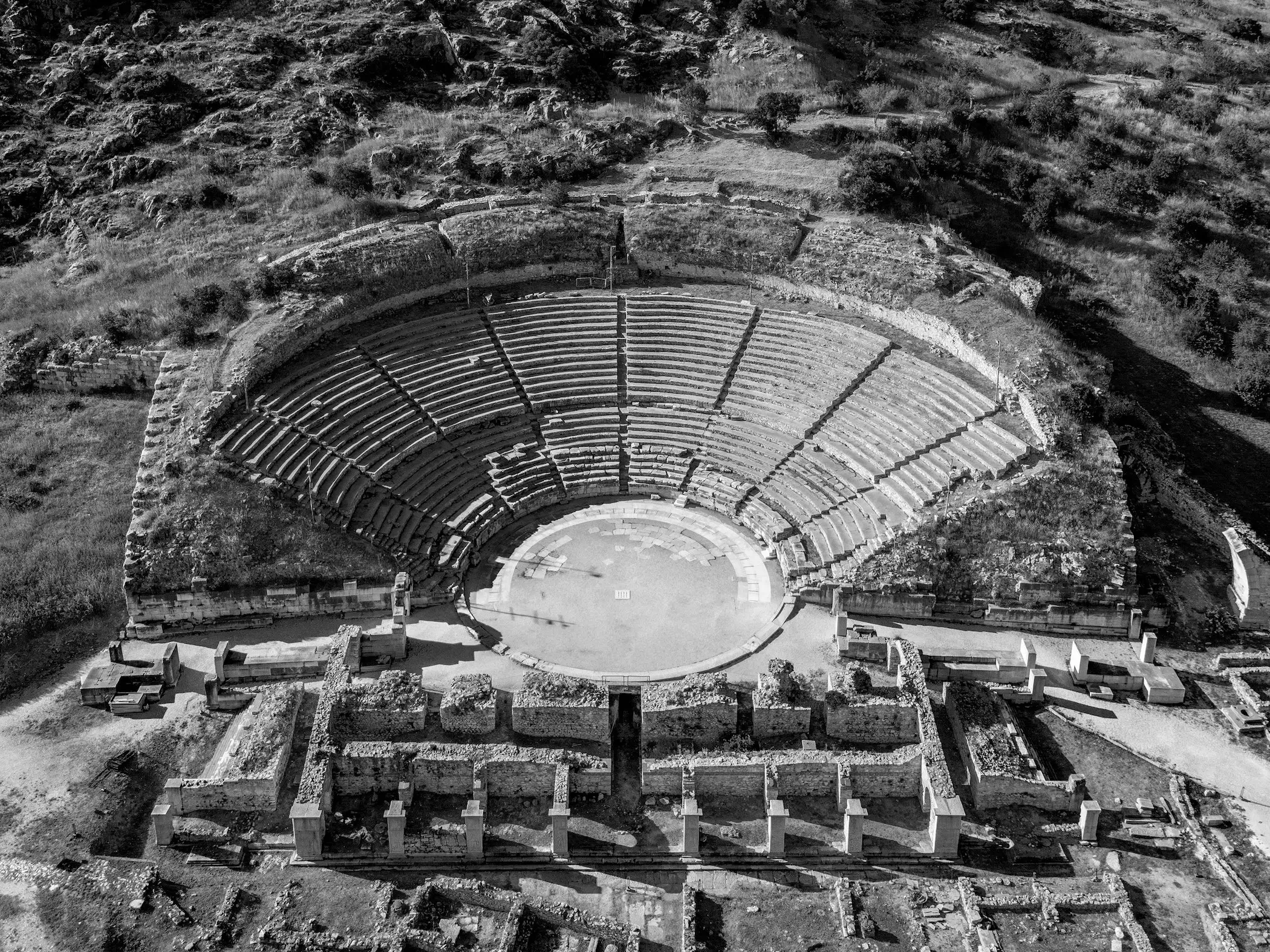
The Ancient Theater of Philippi, built in the mid-4th century BC, is one of the earliest stone theater buildings in Greece. It is located at the foot of the acropolis and faces south, offering a panoramic view of the ancient city. In its original form, it was constructed of marble.
Fragments of the theater building from the Late Classical and Hellenistic periods have survived. The retaining walls of the cavea that supported it to the east, west, and south date from this period. We do not have sufficient information about the form of the stage, which leads to the assumption that it was a wooden structure that has not survived.
During the Roman period, the theater took on a strong public and political character, serving as a venue for showcasing imperial power. In the 2nd century AD, a magnificent three-story stage building with a wooden proscenium was erected. The orchestra was enlarged, as was the cavea above the aisles. The seats were extended, the aisles were covered with arches, and the sculptural decoration of the stage was dominated by Dionysian themes, emphasizing the theater’s connection with the cult of Dionysus.
South of the stage was a paved square, which in early Christian times was covered by newer buildings.
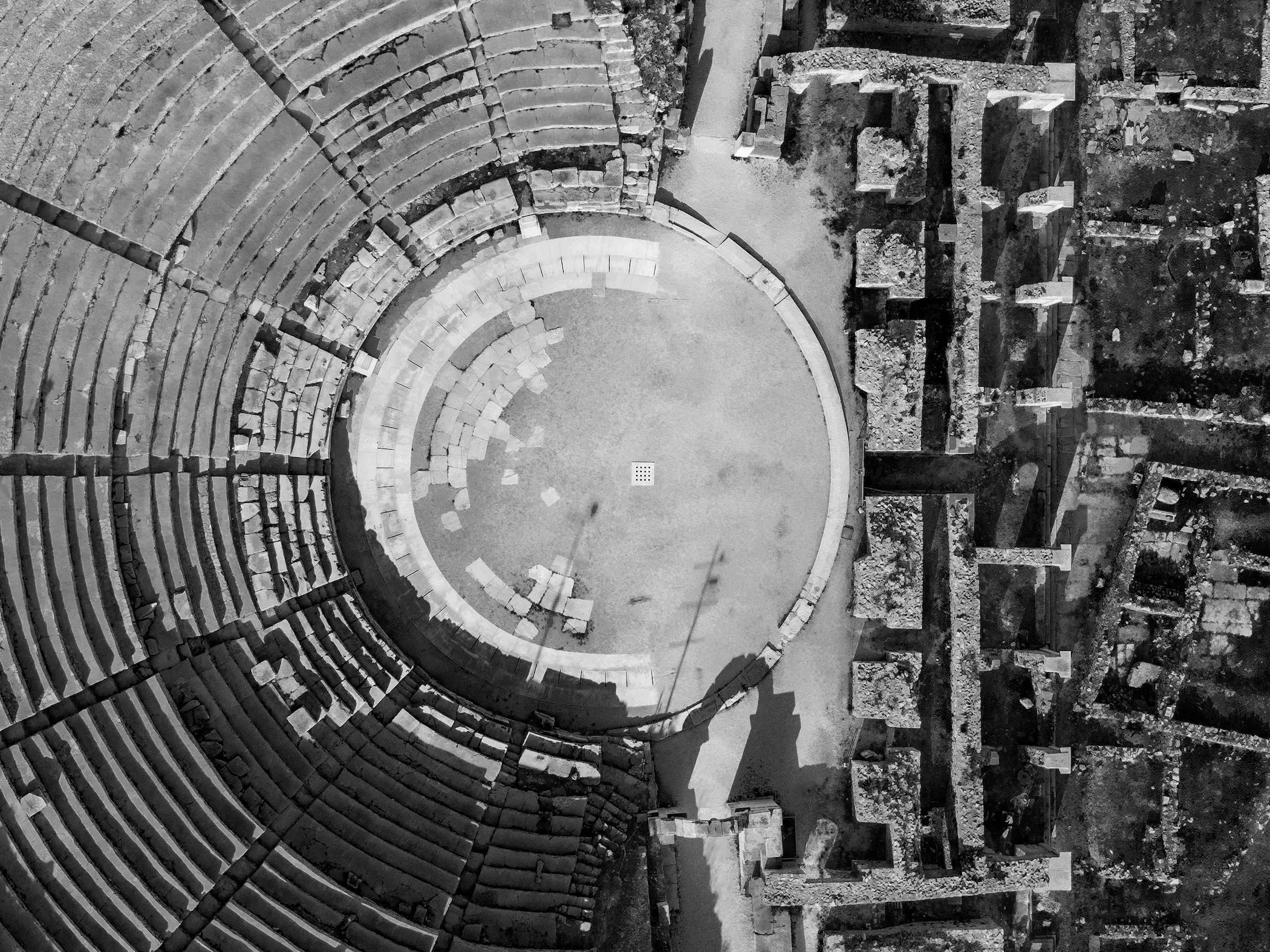
Between the 2nd and early 3rd centuries AD, the theater was converted into an arena. The proscenium was demolished, the floor of the proscenium was raised, the orchestra was shaped into a circle, the first two rows of seats in the cavea were removed, and a stone parapet and railings were constructed to protect the spectators.
In its current form, the cavea has shaped seats and steps made of rough stone covered with cement mortar. A diazoma divides it into two sections, each of which is divided into eight tiers. The lower section has ten rows of seats, while the upper section is estimated to have had ten to twelve rows.
Excavations and restoration
The theater was gradually uncovered between 1921 and 1937 by the French Archaeological School.
In 1957, as part of the revival of ancient drama in historic theatres, excavation and restoration work resumed, prompted by the first performance of the Philippi-Thasos Festival. Since then, the monument has undergone two more major excavation periods (1975–1992 and 1992–2000).
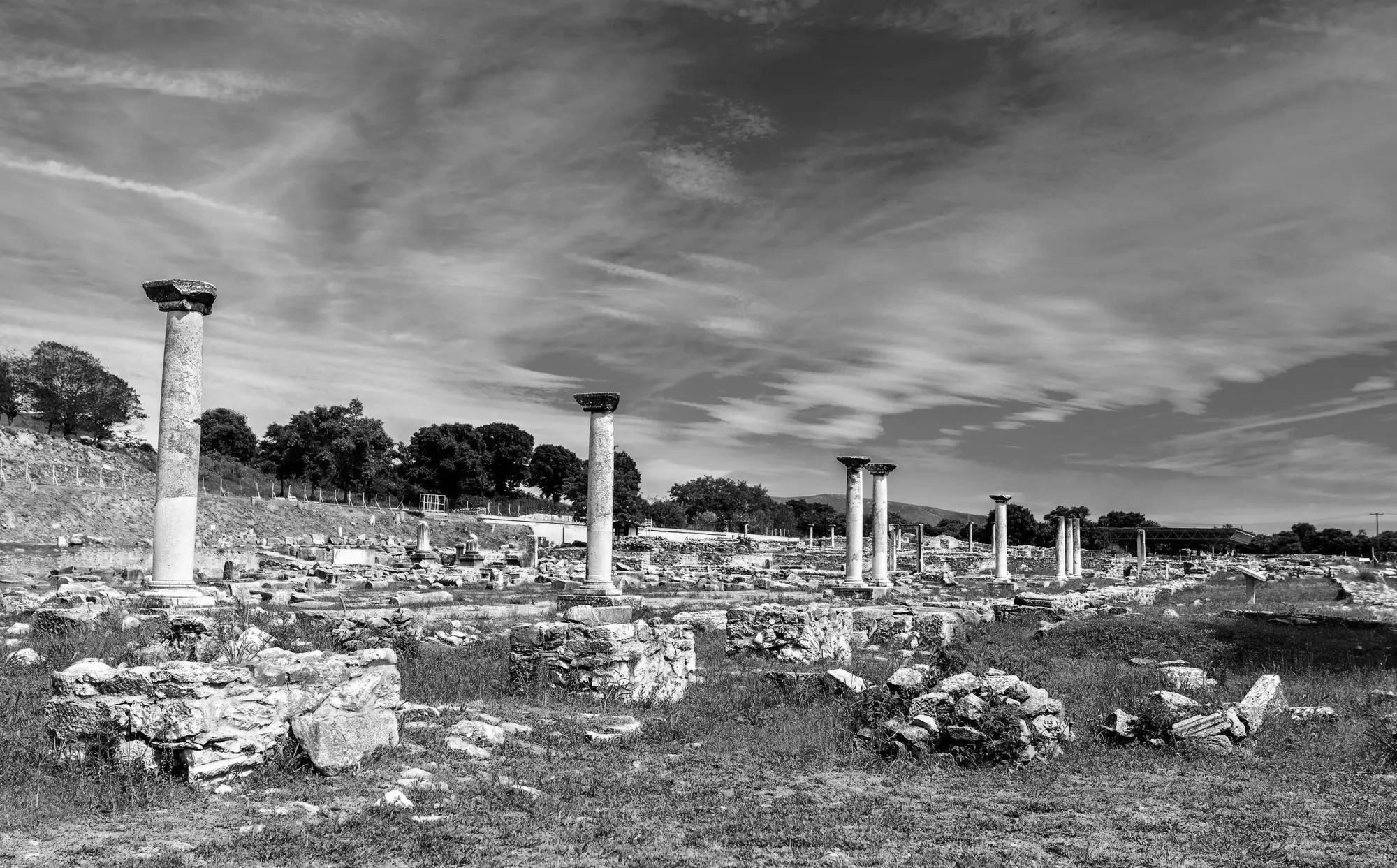
In 2001, the project “Restoration of the Ancient Theater of Philippi” was included in the Third Community Support Framework. During this period, excavations were completed on the stage, orchestra, corridors, and epitheatre, while extensive maintenance, reinforcement, restoration, and reconstruction work was carried out.
In 2005, the restoration of the western proscenium of the theater was completed, as well as the excavation of the area between the western portico and the proscenium.
In 2016, the archaeological site of Philippi was added to the UNESCO World Heritage List, becoming the 18th monument in Greece to receive this distinction. This recognition was based on the city’s development over time, from the Hellenistic to the Byzantine period, and its undeniable universal value.
Today, the Ancient Theater of Philippi remains a vibrant cultural site, where history meets contemporary artistic creation, and every summer the monument is reactivated as a place of lively dialogue.
OLD MUSIC (Halil Bey Mosque)
The Old Music Building, known as the Halil Bey Mosque, is located in the center of the Panagia peninsula, near the Fortress and at a key point where the roads leading to the acropolis and the gates of the walls converge. It is estimated that it was built around 1530, during the reconstruction of the city.
Excavations by the 12th Ephorate of Byzantine Antiquities revealed the remains of the three-aisled early Christian basilica of Agia Paraskevi, as well as a small Byzantine cemetery. The archaeological finds are visible through the glass floor of the building, making the site a unique example of the coexistence of monuments from different historical periods.
The mosque was part of a larger complex that included a madrasa (religious school) with eight student rooms, which is still in good condition. At the beginning of the 20th century, a girls’ school operated there, while during the period 1930-1940, the building housed the Philharmonic Orchestra of the Municipality of Kavala, which led to the establishment of the name “Mosque of Music” and, eventually, “Old Music.”
After restoration and renovation work carried out by the Ephorate of Antiquities and the Municipality of Kavala, the site was opened to the public and now functions as a venue for cultural events where contemporary artistic expression interacts directly with the stratification of history.
The sense of intimacy it creates provides an ideal setting for small-scale performances, musical events, readings, and activities that require direct contact with the audience.
FORMER LORD BUILDING
The former Lord building is located in the Perigiali area, in a zone of Kavala that still bears traces of the city’s old craft and manufacturing activity. Its inclusion in the Philippi Festival program expands its cultural map, taking the action beyond the historic center.
With its characteristic repetitive roof shells and clean linearity of its volumes, the building retains a strong identity and serves as a unique setting for contemporary artistic activities. Its open and flexible interior allows for different forms of presentation.
For the viewer, the experience differs from that of historical monuments: the scale and proportions of the space, the natural light diffused by the glass windows in the upper part of the walls, and the rough materiality of the surfaces create an immediate and contemporary environment where artistic practice takes on a special intensity.
Its reuse as a cultural space highlights the potential for transforming urban memory, turning a former production site into a place of contemporary creation.